
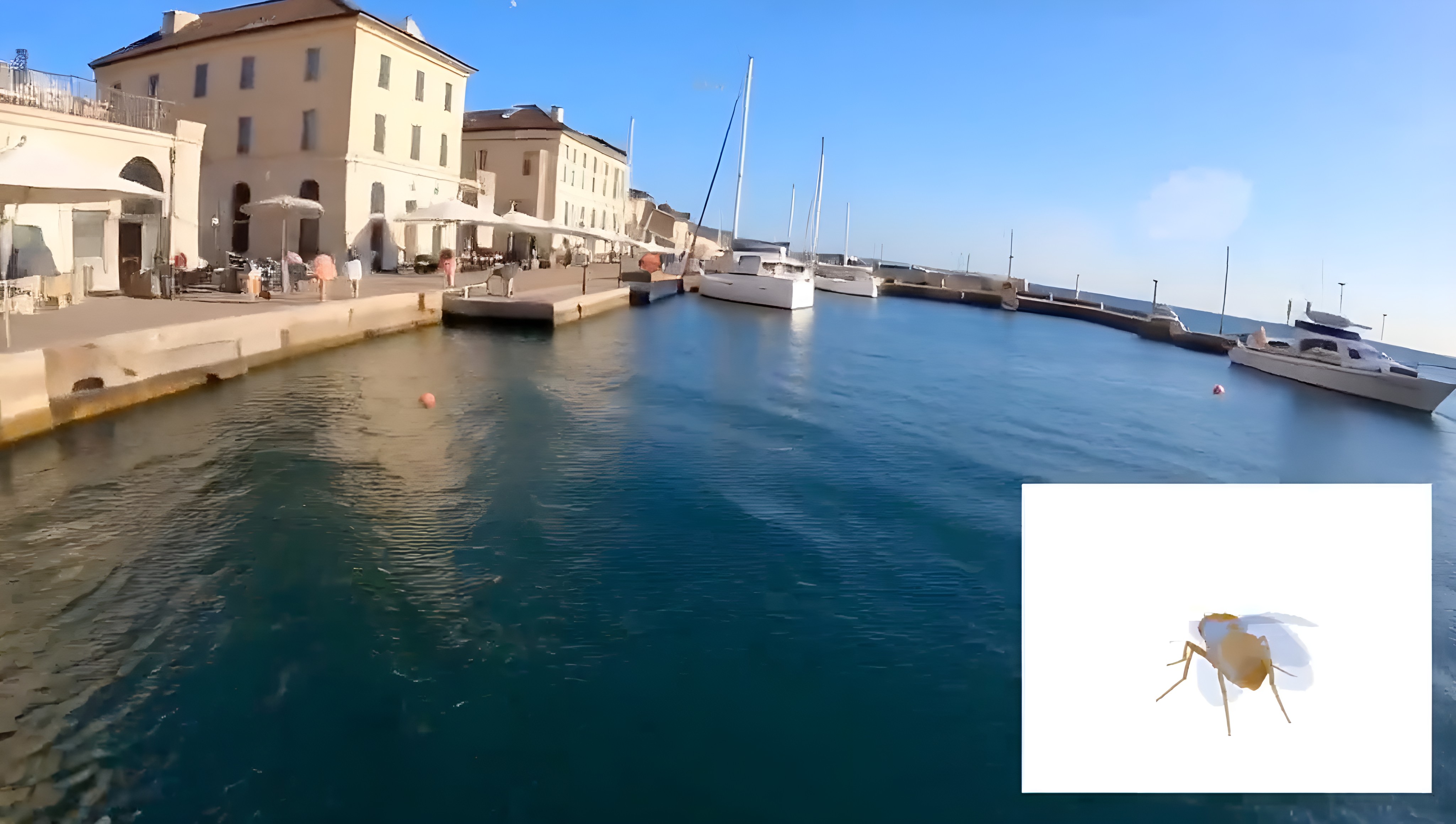
A virtual agent powered by the simulation of a fruit fly's brain began to autonomously navigate through a synthetic world generated frame by frame by a visual language model. The decidedly astonishing demonstration was unveiled by the American company Odyssey through a post on the X platform, where they shared a video in which the digital insect displays complex flight behaviors in an environment that does not use a traditional physics engine, but rather a generative system of 14 billion parameters, known as Odyssey-3.
The breakthrough stands out for uniting two advanced branches of technological research: biological sensorimotor simulation and physical AI. According to the information provided by the company itself, the experiment establishes a closed loop in which the world model renders the visual environment perceived by the agent, while the simulated brain responds by processing the images and emitting motor signals that alter the view generated in real-time. As the company stated in its official release, "Odyssey-3 generates the agent's perception in real-time, while the insect's brain simulation converts that visual flow into flight movements within the environment."
However, the announcement has raised reservations in the scientific community due to the absence of formal technical documentation. Odyssey has not published a research paper, source code, or detailed specifications that would allow auditing the experiment. Although the video shows a smooth flight path, it has not been clarified which specific connectome served as the basis for the neural architecture, nor how the electrical activity of the neural networks was translated into directional commands within the simulated environment.
Why it matters
The integration of neural simulations into generative world models represents a fundamental conceptual shift in the development of physical AI and autonomous robotics. Traditionally, autonomous navigation and connectomics experiments have been conducted within static and preprogrammed physics engines like MuJoCo, or in rigid computational environments like the video games Minecraft or Doom. In those schemes, every object, collision, and gravity rule must be explicitly coded by software engineers, which limits the variability of test scenarios.
By replacing the physics engine with a generative model like Odyssey-3, the possibility opens up to expose autonomous agents to virtually infinite and dynamic synthetic environments. For the artificial intelligence industry in Latin America and globally, this type of architecture offers a conceptual framework for training robotic systems, drones, and autonomous vehicles in realistic simulations without the need to collect petabytes of video in the real world or build costly physical models.
However, various researchers in computational neuroscience remind us that having the structural map of an organism's brain is not equivalent to replicating its biological functioning. Without clear equations of neuronal activation and verifiable sensorimotor translation rules, it is difficult to determine whether the agent acts through a rigorous connectomic simulation or through a simplified approximation optimized for visual demonstration.
What's next
The next essential step for Odyssey will be the publication of a detailed technical report that subjects its findings to peer review. The artificial intelligence and neurobiology community expects the startup to disclose the methodology used to process the visual inputs of the world model and convert them into electrical impulses for the neural network, as well as the agent's performance metrics under different environmental conditions.
In terms of technological development, the company plans to use the Odyssey-3 architecture to scale the training of agents on various hardware platforms. The medium-term goal is to transfer these autonomous navigation capabilities from synthetic environments to real physical applications, including robotic arms, humanoid androids, and navigation systems for the automotive industry.
For their part, independent connectomics research laboratories will continue to analyze whether this type of generative sensorimotor loops can be integrated in a standardized way into open-source platforms. If Odyssey's methodology proves replicable, it could become a standard for evaluating how simulated biological neural networks react to changing and unpredictable stimuli in real-time.
Context
The map of the fruit fly's brain (Drosophila melanogaster) is considered one of the greatest achievements of modern neuroscience. In recent years, large-scale initiatives like the FlyWire consortium and the MaleCNS project have managed to reconstruct for the first time the complete synaptic wiring diagram of this insect's central nervous system. These maps cover between 139,000 and 166,000 neurons and more than 50 million synaptic connections, meticulously mapped using high-resolution electron microscopy.
The use of these structural data in computational environments is not entirely new. Previous scientific projects have loaded variants of the connectome into simulators to analyze biological responses to tactile or optical stimuli, using mathematical models of neuronal activation such as leaky integrate-and-fire. However, most of these models operated in isolated systems where the sensory input was predetermined and the results did not dynamically affect the surrounding environment.
Founded by Oliver Cameron and Jeff Hawke —former executives with backgrounds in autonomous driving companies like Cruise, Wayve, and Voyage— Odyssey was created with the goal of applying generative world models to physical AI. The startup launched Odyssey-3 as a high-fidelity visualization and simulation model trained with extensive datasets of physics and spatial perception, and achieved outstanding results in physical reasoning tests like Physics-IQ before presenting this demonstration with the simulated biological agent.
In any case, today's achievement was received with excitement on social media, especially for its implications, more than technological, metaphysical and ontological. As one user said on X: "From now on, no fly can know for sure if it lives in a real world or a simulated one. It must be incredibly depressing."